Pharmaceutical Water Systems: Aqua Purificata, Water for Dialysis, Pure Steam
Pharmazeutische Wasseraufbereitungs-
anlagen:
Aqua purificata, Wasser für Dialyse, Reinstdampf
When Does a Company Need Purified Water?
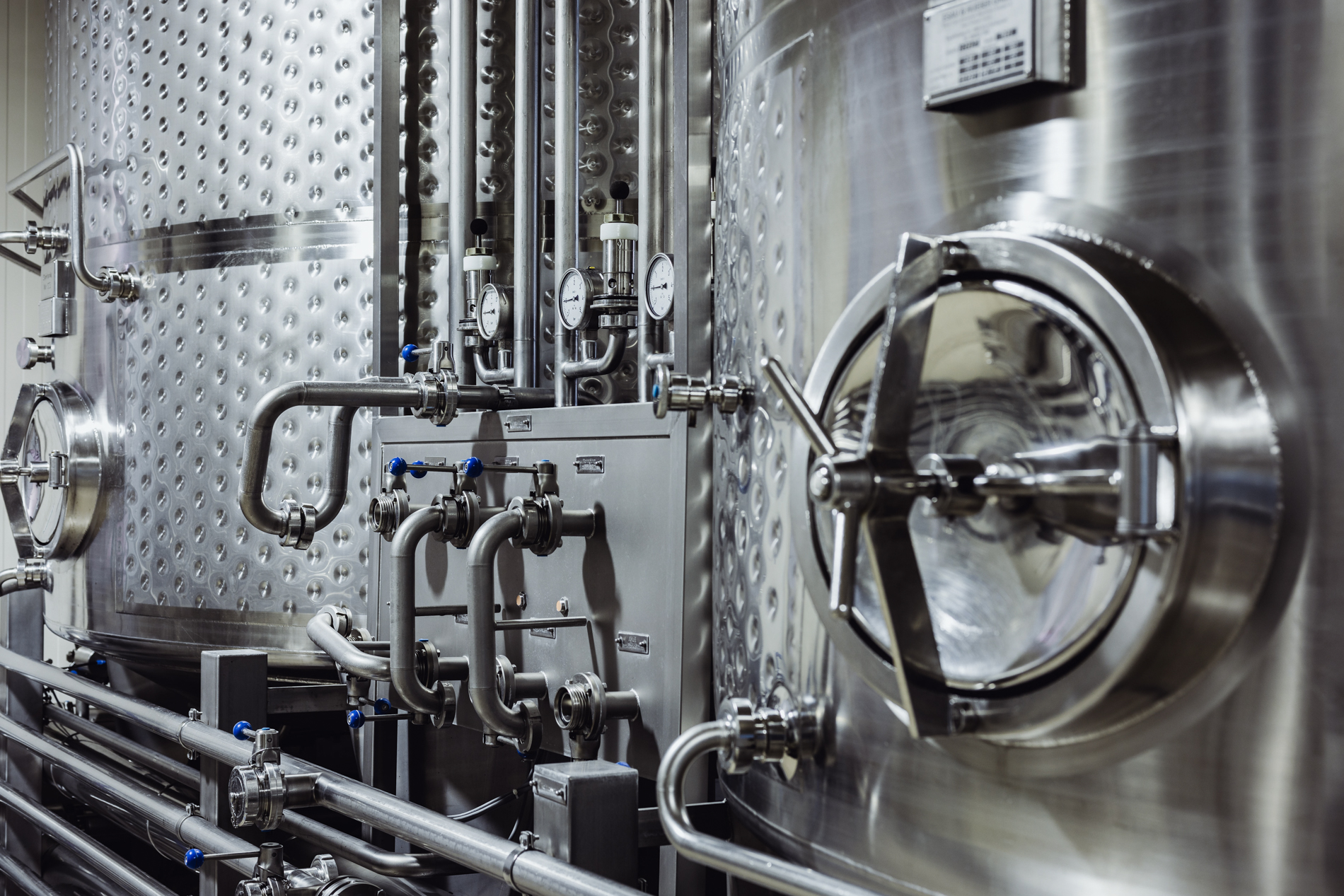
In industries like pharma, where high-purity substances are essential, the use of purified water plays a decisive role. There, purified water is used both as an ingredient and as a cleaning agent. The manufacture of medicinal products requires water of the highest purity, to prevent contamination and safeguard product quality.
Pharmaceutical Water Systems from a Single Source
QP-Engineering offers you customized solutions in the field of pharmaceutical water treatment, covering both cold and hot generated ultrapure water. In doing so, we offer you not only comprehensive consulting and planning but also accompany your project right up to the release of the media.
We specialize in the following areas of water treatment:
- Pharmaceutical manufacturing
- Laboratory technology
- Electronics industry
- Food industry
- Cosmetics industry
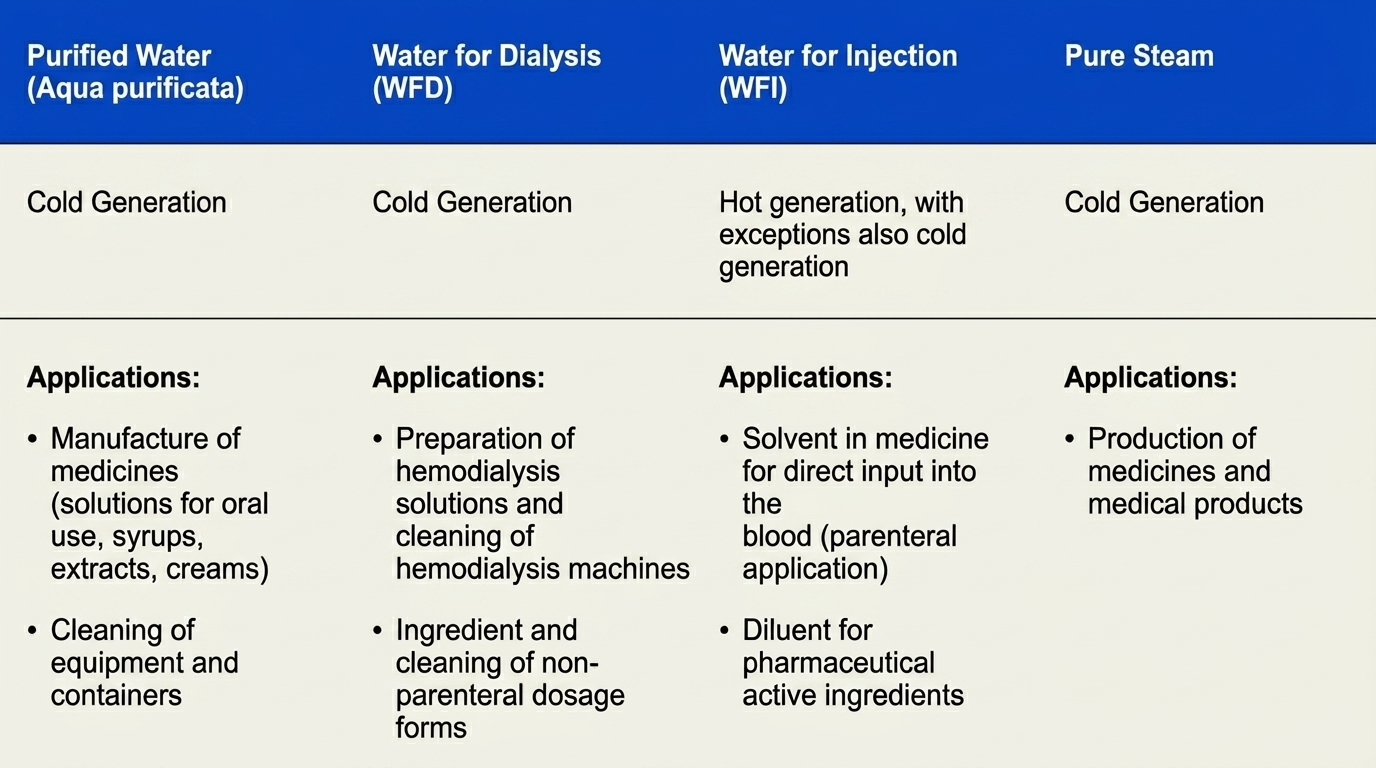
DEFINITION & APPLICATION
Wie wird Reinstwasser erzeugt und wo wird es verwendet?
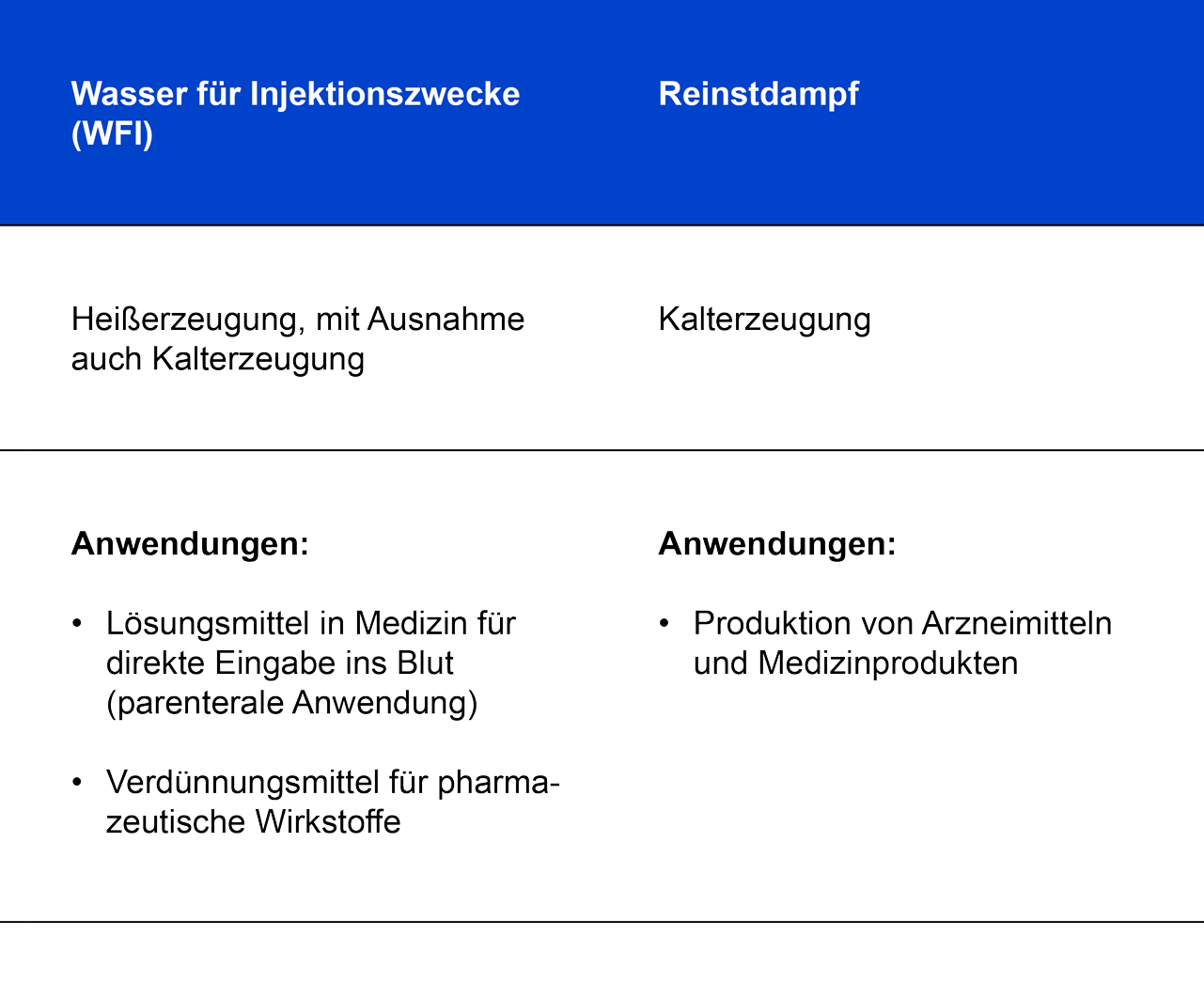
| Gereinigtes Wasser (Aqua purificata) | Wasser für Dialysezwecke (WFD) | Wasser für Injektionszwecke (WFI) | Reinstdampf |
|---|---|---|---|
| Kalterzeugung | Kalterzeugung | Heißerzeugung, mit Ausnahme auch Kalterzeugung | Kalterzeugung |
| Anwendungen:
– Herstellung von Arzneimitteln (Lösungen zum Einnehmen, Sirupe, Extrakte, Cremes) – Reinigung von Geräten und Behältern
|
Anwendungen:
– Zubereitung von Hämodialyselösungen und Reinigung von Hämodialysegeräten – Einhaltsstoff und Reinigung von nichtparentalen Darreichungsformen |
Anwendungen:
– Lösungsmittel in Medizin für direkte Eingabe ins Blut (parenterale Anwendung) – Verdünnungsmittel für pharmazeutische Wirkstoffe
|
Anwendungen:
– Produktion von Arzneimitteln und Medizinprodukten
|
Sie planen eine neu Reinstmedien-Anlage oder benötigen Unterstützung bei der Qualifizierung?
Sprechen Sie uns gerne an
Top-Quality Purified Water for Your Production
We provide solutions for the generation of purified water that meets the highest quality standards. This kind of purified water is essential for critical production processes in the pharmaceutical industry. Our experienced team specializes in the design, implementation, and maintenance of GMP-compliant water systems. Here's how we ensure your water systems stay GMP-compliant:
- Analysis of Water Demand: We conduct a detailed analysis of your specific water demand to precisely understand and define the requirements for water quality and water usage.
- Design of Water Treatment Systems: Based on the needs analysis, we develop individually tailored concepts for water treatment systems that are precisely aligned with your production processes and requirements.
- Implementation of Filtration Technologies: We implement custom-fit filtration technologies to ensure that the ultrapure water generated is free from particles, microorganisms, and other contaminants. This is crucial for compliance with GMP standards.
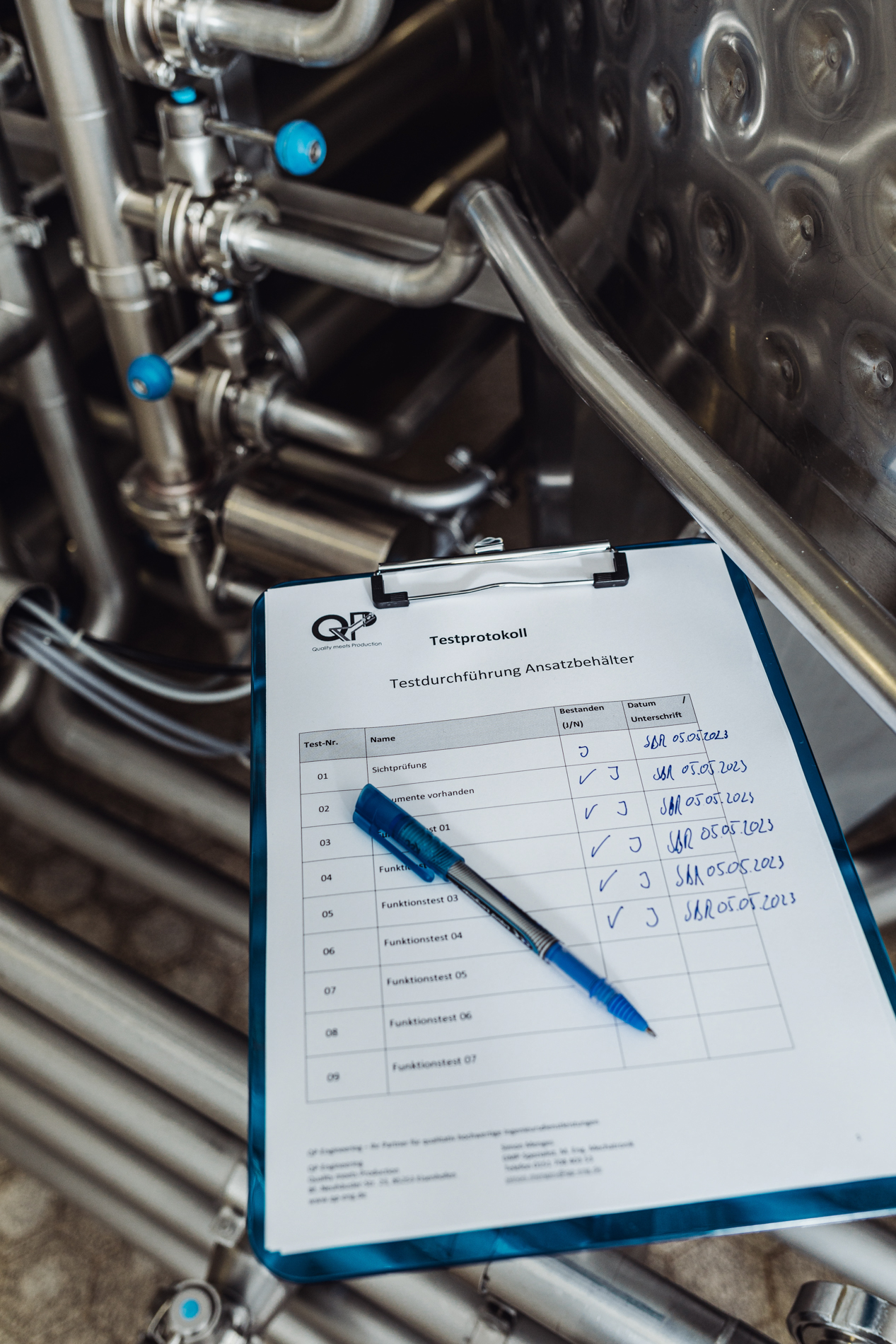
- GMP qualification procedures: Our experts carry out comprehensive qualification procedures to verify and validate the performance and compliance of your water systems. This includes DQ, IQ, OQ, and PQ procedures.
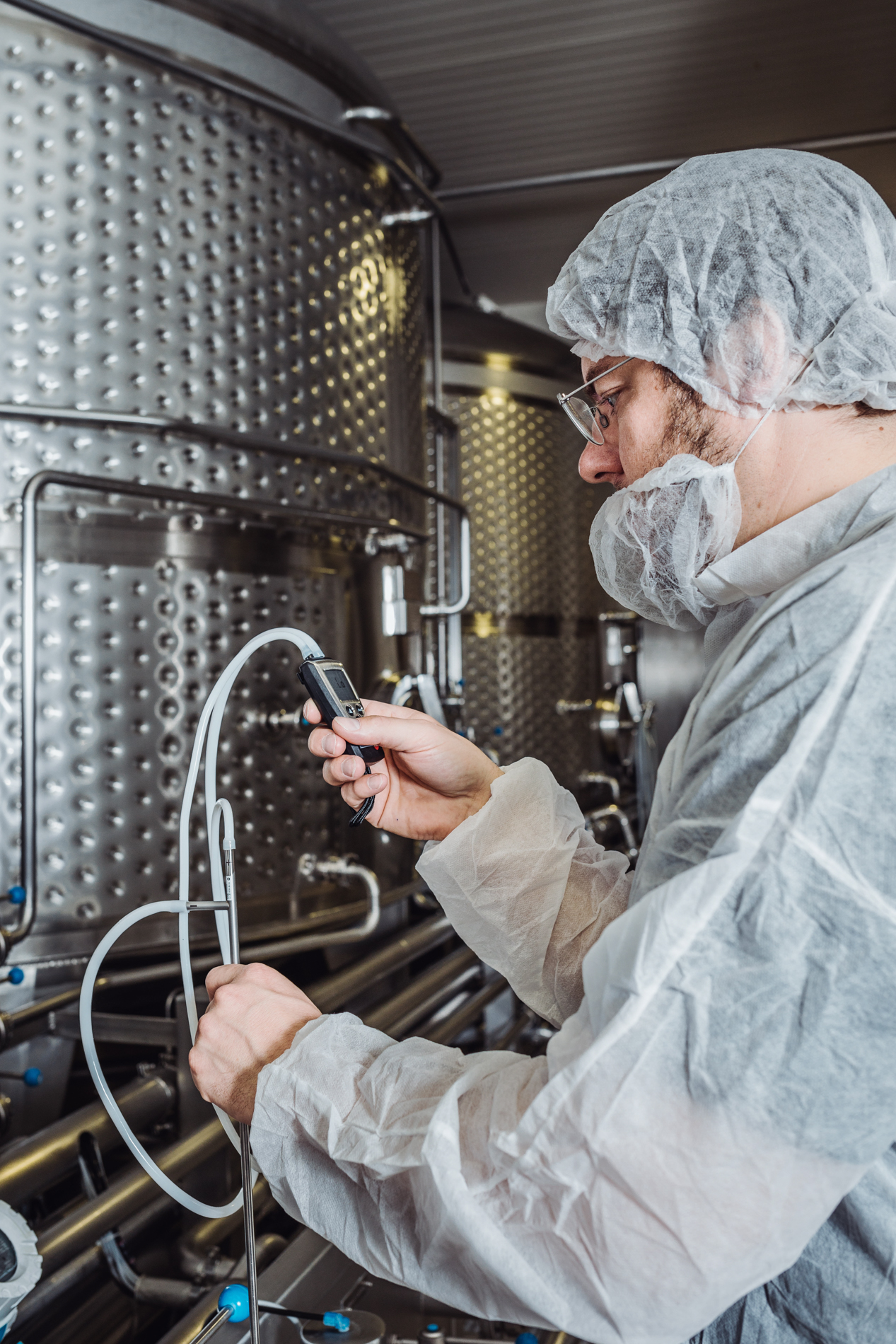
- Continuous Monitoring and Maintenance: To guarantee the long-term reliability and conformity of your systems, we offer GMP services for the continuous monitoring and maintenance of your water treatment facilities. This includes regular inspections, functional tests, and, if necessary, the replacement of components.
We Support You with GMP-Compliant Water Systems
QP-Engineering accompanies you in the implementation and optimization of GMP-compliant water systems:
- Cold water treatment: This method is suited to applications where water is used at room temperature. We use specialized filtration systems, UV treatment, and ion exchange processes to generate water of the highest purity.
- Hot water treatment: For processes requiring hot or steam-water mixtures, we offer systems that can operate safely and effectively at high temperatures. These systems are specifically designed to preserve the integrity of the water during the heating process.
QP-Engineering: Your Partner for GMP-Compliant Pharmaceutical Water Systems
We offer you a complete package for your projects regarding pharmaceutical water treatment according to GMP standards – all from a single source. This is your benefit with QP-Engineering as a GMP partner for your water treatment:
Support for Qualifying GMP-Compliant Water Systems
Do you want to qualify your pharmaceutical water system? We support you reliably and competently in qualifying your water systems to GMP standards:
QP-Engineering: Your Partner for GMP-Compliant Pharmaceutical Water Systems
In the pharmaceutical industry, GMP-compliant water treatment is essential. The purity and quality of the water used for production must be guaranteed in every production step. Our experts know the specific and high demands placed on water treatment in pharmaceutical production. We do not just offer support to meet these standards. We also work closely with you to optimize your water treatment processes. This ensures that the pharmaceutical water produced is GMP-compliant and can be safely used in your production process.
Frequently asked questions about GMP water systems
Pharmaceutical water is water that has been specifically prepared and purified for pharmaceutical and medical applications. This water must meet strict quality standards to ensure that it is free of contaminants and microorganisms. The production of pharmaceutical water requires dedicated water treatment systems and rigorous controls to ensure that the required quality standards are met.
The requirements for pharmaceutical water vary depending on the intended use. In general, it is classified into different quality grades, including:
- Water for Injection (WFI): This is the highest quality grade and is used for the production of injectables and parenteral medicines (administered by injection). WFI must be virtually free of any contaminants and microorganisms.
- Purified Water (PW): This is highly purified water used in many pharmaceutical processes, such as the production of medicines, ointments, and creams. It must meet specific purity requirements to ensure that it is suitable for these applications.
- Water for Manufacturing (HPW): Often used for the production of non-injectable medicines, where the purity requirements are less strict than for WFI or PW.
- Water for Dialysis (WFD): Used for hemodialysis, a procedure for cleaning the blood in patients with kidney failure. It must be free of contaminants such as bacteria, endotoxins, and heavy metals to protect patient health.
The difference between purified water and distilled water lies in the production method, the degree of purity, and the applications. Purified water is produced specifically for critical applications, such as those in the pharmaceutical and biotechnology industries, and must meet strict quality standards.
Quality is often measured by the water's resistance, which at 25 °C corresponds to a calculated limit value of 0.055 µS/cm, equal to a resistance of 18.2 MΩcm (megohm-centimeters). By comparison, the resistance of distilled water is between 0.5 and 5 µS/cm at 25 °C.
Distilled water is used for less demanding applications, such as filling irons or batteries. The difference in purity level and manufacturing methods makes ultrapure water the preferred choice for high-quality scientific and pharmaceutical purposes, while distilled water is used in less demanding situations.
Pharmaceutical water is produced using pre-treatment, reverse osmosis, ion exchange, ultrafiltration, and other procedures. The choice of individual treatment stages and methods depends on the requirements for the pharmaceutical water, whether it is for Water for Injection (WFI), Purified Water (PW), or other pharmaceutical qualities. The entire facility for the production of pharmaceutical water is qualified, validated, and monitored in accordance with applicable regulations and GMP standards to ensure the quality and purity of the water.
Ultrapure water (Purified Water, PW) generally has a pH value that is nearly neutral, i.e., around 7.0 at 25°C. However, the pH value can vary slightly depending on various factors such as the environment and the temperature. If ultrapure water is exposed to the atmosphere, the actual value can be lower than the original pH value of 7.00. In this case, the pH value could drop towards 5.20 due to the formation of carbonic acid. This highlights the importance of strict control over water treatment processes and the quality of ultrapure water.